
Tacoma, WA · Garage Door Service
Is Your Older Tacoma Garage Door Worth Fixing
Most Tacoma houses date to 1962-2003. Here's how that build era and our mild, damp climate decide whether your garage door is worth repairing or replacing.
- Repairs & new doors
- Springs & openers
- Serving 4 nearby communities
Leaving It Alone
A door that still opens and closes on an older Tacoma house isn't automatically a problem. Most of the housing stock here went up between 1962 and 2003, with the median sitting around 1987, which means a huge share of the doors we look at are original or close to it - steel sectional doors on extension or torsion springs that were standard for that era. If the door is quiet, the track is straight, and the opener still reverses on contact, you don't need to replace anything just because it's thirty-some years old. Age by itself isn't a failure mode. What matters is whether the hardware is still doing its job: springs holding tension evenly, rollers not chipped down to the stem, cables free of fraying. A door from the 1987 median build year can still be running on its original torsion spring, and if that spring is balanced, there's no reason to swap the whole unit. We'd rather tell a homeowner their door has another ten years in it than sell a replacement that wasn't needed. The honest version of this section is: most of the service calls we run on 1980s and 90s doors end in a spring or roller job, not a new door.
How Local Conditions Play In
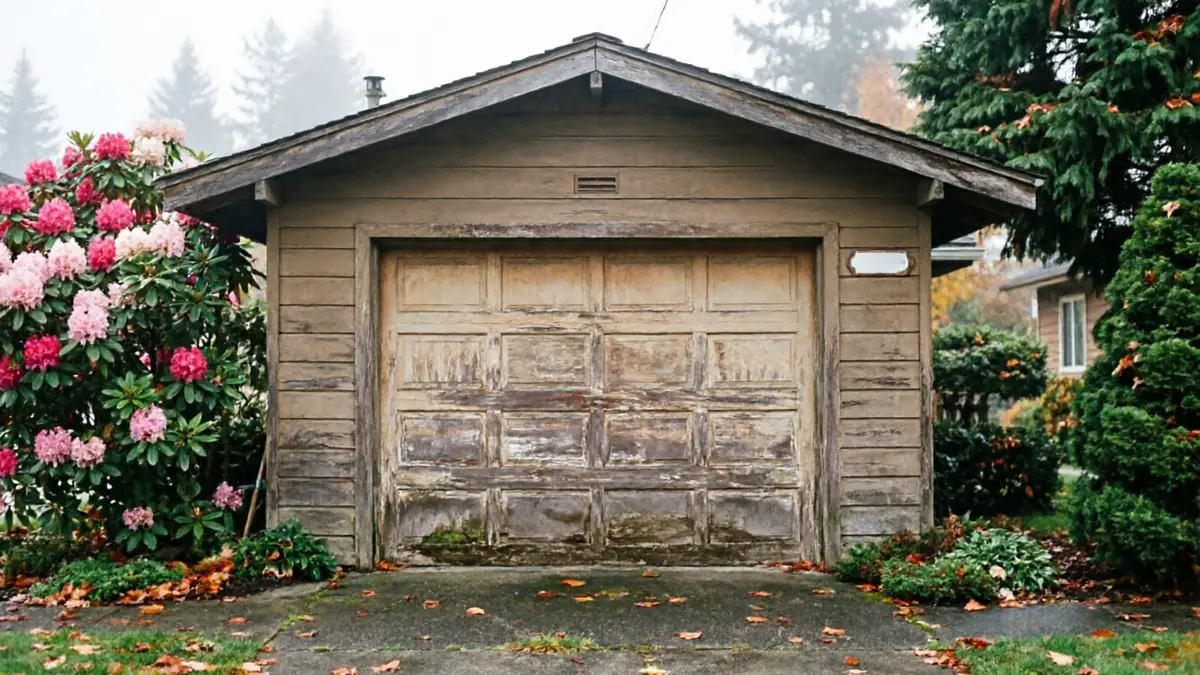
Tacoma sits in a mild climate band with occasional freeze, not the deep-freeze cycling that cracks seals and warps panels elsewhere, and not the dry heat that dries out lubricant fast either. That matters for how these older doors actually fail. On a 1970s or 80s steel door here, the common failure isn't the panel - it's the galvanized hardware that's spent three or four decades in damp Pacific Northwest air without ever freezing hard enough to force a full seasonal maintenance habit. Springs lose tension gradually rather than snapping from cold shock. Track bolts loosen from humidity-driven rust rather than ice expansion. Bottom seals on original doors are usually more weathered than cracked, since there's rarely a hard freeze to split rubber outright. That changes the repair math: on a door built in that 1962-2003 window, we're often looking at corrosion on fasteners and worn-out lubrication on tracks before we're looking at panel damage. A door that's structurally fine but mechanically tired is a repair job. A door with rusted-through bottom panels from decades of damp ground contact is a different conversation.
Where People Go Wrong
The mistake we see most with Tacoma's older housing stock is treating the opener and the door as one unit. A homeowner in a house from the 1980s median era calls because the door won't open, assumes the whole system is dead, and starts pricing a full replacement - when the actual problem is a worn drive gear or a chain that's jumped a tooth on the opener, with the door itself and its original torsion spring still in good working order underneath. The reverse mistake happens too: people keep throwing opener parts at a door whose spring has actually lost half its lift, so the opener motor is straining to do a job the spring used to handle, burning out gears that didn't need to fail. On a 1962-2003 house, those two systems age at different rates, and diagnosing them separately before quoting anything is the only way to avoid replacing good parts. We won't quote a new door over the phone without seeing which system is actually failing.
The Situation
If you're in a Tacoma-area house built anywhere in that 1962-2003 stretch - which covers most of the 42 named areas we work across, from Hilltop and Central Tacoma out toward South Hill and Spanaway - the honest question isn't age, it's condition of three things: spring tension, track alignment, and whether the panel material has rusted or warped. A door that fails on one of those is a repair. A door failing on two or more, especially with panel rust from sitting low to damp ground for decades, usually isn't worth sinking more parts into. We don't push replacement on a door that's still structurally sound just because it's old enough to qualify. We also won't tell you a rusted-out bottom panel and a dead spring together are a quick fix, because they aren't. The call comes down to what we actually find on the track and the spring, not the build year on its own.
Frequently asked questions
My garage door is from the 1980s - should I just replace it now?
Not automatically. A lot of Tacoma houses have original doors from that era still running fine. If the spring holds even tension and the panels aren't rusted through, a repair usually makes more sense than a full replacement, even on a door that old.
Why does my old door's spring fail without any warning cold snap?
Tacoma's climate is mild with only occasional freeze, so springs here usually lose tension gradually from age and humidity rather than snapping from a hard cold shock. That's why an older spring can seem fine for years and then suddenly feel heavy or uneven.
Is rust on the bottom panel a sign the whole door is done?
It depends how far it's spread. Surface rust on a door that's sat near damp ground for decades is common and often cosmetic. Rust that's eaten through the panel metal itself is structural, and at that point repair isn't the better value.
Related garage door services in Tacoma
More garage door guides
Book garage door service in Tacoma
Call now or request a quote - tell us what the door is doing and where you are.