
Tacoma, WA · Garage Door Service
Why Safety Sensors Drift in Tacoma Garages
Tacoma's 1962-2003 housing stock and mild-with-freeze climate mean sensor brackets shift over decades. Here's why alignment drifts and when to leave it alone.
- Repairs & new doors
- Springs & openers
- Serving 4 nearby communities
Leaving It Alone
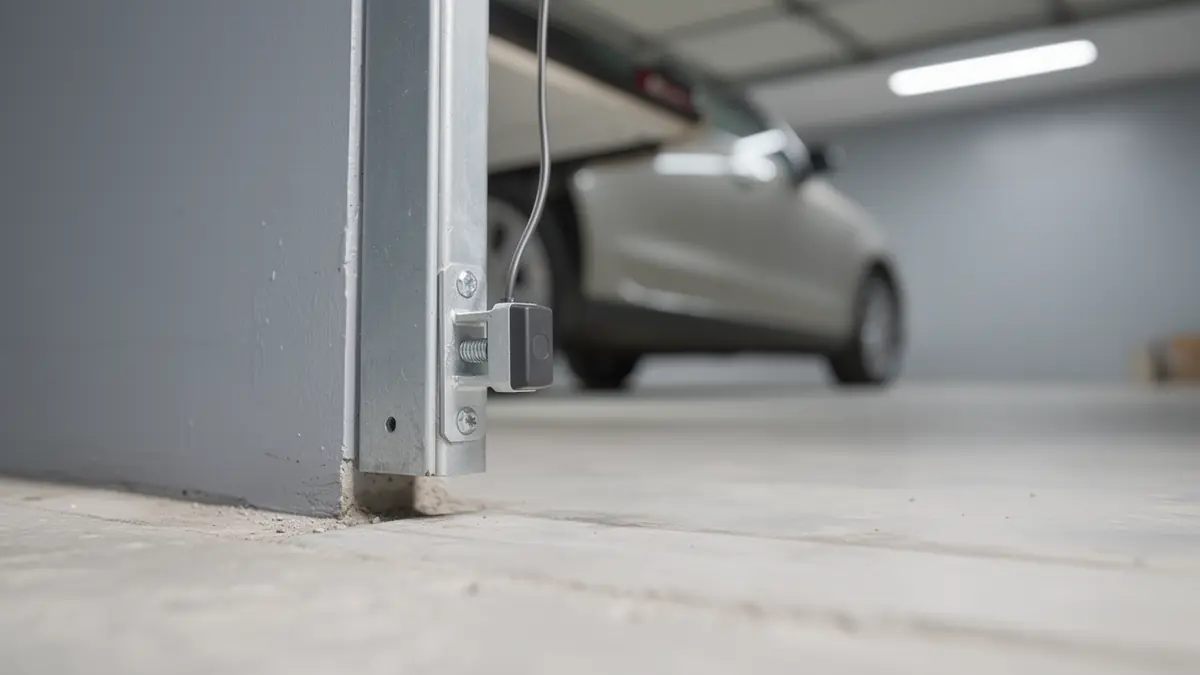
If your opener reverses before the door touches the floor, or the light on one sensor blinks instead of staying solid, your first move should be nothing. Don't grab a wrench and start loosening brackets. Most of the houses we work on here went up between 1962 and 2003, with a lot of that stock dating to the mid-80s, and the sensor brackets on those original tracks were set once, decades ago, by whoever installed the door. Touching them without knowing what shifted them in the first place usually makes the misalignment worse, not better. A sensor that's off by a quarter inch can still throw the beam far enough to trip a false reversal. If the door still closes all the way and reverses cleanly on obstruction, you likely don't have a wiring problem - you have a bracket that's walked a few degrees out of true. Leave it alone long enough to actually watch what the door does over two or three cycles before you touch anything. That tells you more than guessing.
How Local Conditions Play In
We sit in a mild climate with occasional freeze, which sounds easy on garage hardware compared to places with hard winters - and it mostly is. But mild-with-freeze is exactly the condition that works brackets loose slowly instead of cracking them fast. Slabs and track mounts here see small expansion and contraction swings through the year rather than one brutal freeze-thaw cycle, and that slow movement is what nudges a sensor bracket a hair at a time. On a house built in the 1980s or 90s - which covers a large share of the garages we see across the 42 named areas we work in - that's 30 to 40 years of small seasonal shifts adding up. You won't see a dramatic failure. You'll see a sensor that worked fine for years and now trips once a week for no obvious reason. That's not a bad sensor. That's a bracket that's been drifting the whole time and finally crossed the threshold where the beam clips the edge of the lens.
Where People Go Wrong
The most common mistake we see is replacing the sensors when the sensors were never the problem. Homeowners in houses from this era often assume 30-plus-year-old electronics are worn out, buy a new sensor kit, and get the same intermittent fault within a month. The sensors themselves rarely fail outright - they're simple infrared pairs. What fails is the bracket, the mounting screw that's backed out a sixteenth of an inch, or the track itself settling slightly on an older slab. Another mistake is aiming the sensors by eye and calling it done. On original hardware from the 1962-2003 build range, the mounting holes are often slightly oversized from decades of vibration, so a bracket that looks square can still be off enough to cause trouble under certain light conditions. We also see people caulk or foam around the sensor housing to stop a draft, not realizing they've just glued the bracket in a slightly wrong position for good.
The Situation
Here's the honest version: if your door is original to a house built anywhere in that long 1962-2003 window, and nobody's touched the sensors since, we'd bet on bracket drift before we'd bet on bad electronics. The fix is usually a recheck of alignment and a tightened mount, not a parts order. We don't swap sensors on a first visit just because they're old - if the beam lines up and holds after adjustment, that's the job done, and we'll say so even though a sale would be easier. Where we draw the line: if the bracket itself has corroded or the mounting tab has snapped off the track, repositioning won't hold, and that's a mount replacement, not a tweak. We can't tell you which one you've got without seeing the track in person, but the fact that your door still has original hardware from that era is usually the first clue.
Frequently asked questions
Why does my garage door sensor only act up sometimes?
That's the classic sign of bracket drift rather than a dead sensor. On older Tacoma-area houses, brackets shift slightly over years of seasonal temperature swings, and the beam only misses the lens at certain angles or light levels. Intermittent faults almost always point to alignment, not electronics.
Should I just replace both sensors to be safe?
Usually not as a first step. If your door is original to a house from the 1962-2003 era, the sensors themselves are simple and rarely fail outright. We check bracket mounting and track position before recommending new sensors - replacing working electronics doesn't fix a loose bracket.
Can I realign the sensors myself?
You can try, but on original hardware from this build era the mounting holes are often worn slightly oversized, so eyeballing square doesn't guarantee the beam holds. If it drifts back within a week, that's a sign the mount needs more than a quick nudge.
Does our weather actually affect garage sensors?
Yes, indirectly. We don't get hard freezes often, but the mild, some-freeze pattern here causes small seasonal expansion and contraction in slabs and track mounts over many years, which slowly walks brackets out of alignment rather than snapping anything outright.
Related garage door services in Tacoma
More garage door guides
Book garage door service in Tacoma
Call now or request a quote - tell us what the door is doing and where you are.